









Home :: Festival tour :: Konark Dance Festival
KONARK DANCE FESTIVAL
FACTS & FIGURES Time of the year - February |
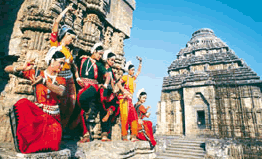
Konark Dance |
THE FESTIVAL
Unique even among India's abundant architectural glories, the Sun temple at Konark is now a World Heritage Site. A few kilometers from Puri and Bhubaneshwar, Konark, like Cuttak, was an active port at the time of the wealthy Kalinga kingdom. The Sun God's immense immobile stone chariot was a landmark on the Orissa coast. But the sea has now receded, and this shrine is now surrounded only by the windswept coastal plains dotted with coconut, cashurina, and mango trees.
The Sun Temple-a magnificent structure designed as the chariot of the Sun God, drawn by seven exquisitely carved horses-is the venue of the annual festival of classical dance and music, the Konark Dance Festival. The festival is held in the month of February every year in the amphitheatre at Konark with the famous Sun Temple as the backdrop.
Music and dance always formed an inherent part of every Indian festival and socio-religious ceremony. Great temples and shrines had their traditional schools of dance and drama, which suffered a decline during the Buddhist, Islamic and British eras.
A host of celebrated classical dancers perform and fill the air with the sound of ghungroo bells, flute and the pakhavaj. Some of the best dancers in the country come to perform amidst the splendor of this ancient temple. It is performed with special illuminations and set-up to transform the Sun Temple, a monument of religious significance, into a temple of art and the atmosphere into one of fantasy.
A marvelous crafts Mela, with a variety of handicrafts and delectable cuisine from various states, adds to the festive mood of this weeklong celebration of Indian classical dance.
The Konark Dance Festival, which was started in a bid to promote Indian classical dances, takes place every year at the Konark Temple, where, since the ancient times, classical forms of dance were nurtured and developed to perfection.
CELEBRATIONS
Many eminent contemporary artists participate in the Konark Dance Festival and enthrall audiences with their performances. At this festival, the connoisseur is able to enjoy and appreciate different Indian classical dance forms at a single venue. The festival has been graced by legendary figures from the world of Indian classical dance like Kelucharan Mahapatra, late Sanjukta Panigrahi, Sonal Mansingh, Padma Subramanium, Meenakshi Sheshadri, Swapna Sundari, Kum Kum Mohanty and Basanti Shreedar.
To add variety, the festival also provides an element of folk rhythm. Interspersed between classical recitals are dance performances by numerous folk troupes from Orissa, Goa, Gujarat, Bihar, Assam and Rajasthan, who enthrall the audience with their traditional steps, instruments and beats.
Though dance dominates the Konark festival, the event is a complete cultural encounter, wherein the traditional arts and craft of Orissa are on display. As part of the festival, there is a crafts mela where artists can be seen working delicate patterns on intricate filigree items, painting on palm leaves and working designs on appliqué work. The festival provides a unique opportunity to the uninitiated to watch and interact with various craftsmen at one place.
As if this is not enough, there are gourmet stalls that dish out
a variety of delicious Indian cuisine. All this adds to the charm
of the week in which the senses are captivated as much by the hypnotic
performances as by the beauty of the backdrop and the variety of
the arts, crafts and cuisine.
LEGENDS
The floodlit Konark Temple, constructed in AD 1225 by King Narasimha Dev of the Ganga dynasty, provides an ideal backdrop to the festival, reviving a scenario of regal splendour and flourishing art forms. Shaped like a chariot pulled by seven horses, the temple is dedicated to the Sun God. According to a myth, the Sun God is believed to have sought a beautiful sea-maiden named Chandrabhaga. After chasing her up to this place, she is said to have disappeared into the sea. A river by the same name, Chandrabhaga, is supposed to have existed just 3 km away from the temple where, as another legend goes, Shamba, the son of Lord Krishna prayed to the Sun God for 12 years to be cured of leprosy. Though now only a small lake exists at the site, the Chandrabhaga mela (festival) is held every year in memory of Shamba's successful penance.
PLACES TO VISIT
Konark, after which the festival has been named, is the place where one can experience the richness of Indian culture through this festival. The town of Konark is at a distance of 64 km from Bhubaneshwar, 36 km from Puri and three km from the coast.




