








Home :: Festival tour :: International Kite Festival-Ahmedabad
INTERNATIONAL KITE FESTIVAL - AHMEDABAD
FACTS & FIGURES Time of the year - January 14 |
 Kite Festival |
THE FESTIVAL
The harassed mother said "go fly a kite" to an over-energetic son who needed to be kept occupied during the holidays. And the little boy happily picked up his guddi and ran out into the field.
That of course, was many years ago. Kite flying has come a long way since then with the invention of motorized and even fiberglass kites-to compete with kite-paper, which was universally accepted as the only material that could fly. However, the tradition of kite flying in India has not changed. Be it during Basant or Makar Sankranti, people of all ages go out into the open to try their luck with their patangs. In towns and cities, where fields are difficult to find, terraces and rooftops are often used for this traditional sport.
In Gujarat, Makar Sankranti is kite-flying day. Traditionally celebrated on January 13 or 14, it is a holiday when every family can be meet outdoors 'cutting' each other's kites. This immensely popular kite flying festival is held in all the important cities of Gujarat. The festival lures expert kite-makers and fliers not only from major cities of India but also from around the world. A plethora of designer kites are also put on display.
The International Kite Festival is always held at Ahmedabad on January 14, to coincide with the festival of Uttarayan or Makar Sankranti. The people of Gujarat celebrate Uttarayan with a lot of enthusiasm and all business comes to a grinding halt for a couple of days. It is also a celebration to mark the end of winter.
CELEBRATIONS
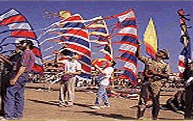
Kite flying begins at dawn and continues without a pause throughout the day. Friends, neighbors and total strangers battle one another for supremacy and cries of triumph rend the air when someone cuts the line of a rival. A tremendous variety of kites are seen and the connoisseur can choose precisely what he wants. Experts specially prepare the lines with which the kites are flown on the great day.
People of all ages gather on terraces or rooftops and engage in kite flying. There is music in the air and traditional delicacies are especially prepared for this day. The Gujarat State Tourism Corporation organizes an International Kite Festival every year and the venue of the event is either the Sardar Patel Stadium or the Police Stadium in Ahmedabad. This festival attracts international kite flyers and local champions as well, who demonstrate their skills in flying exotic kites. Come night and the illuminated kites known as tukals soar into the sky to compete with the stars.
One of the sidelights of the festival is the Patang Bazaar, which is open 24 hours a day in the heart of Ahmedabad during the Makar Sankranti week. A visit to this bazaar in the middle of the night proves beyond all doubt that the entire population of the city is obsessed with patangs and they crowd the streets and buy their stocks while haggling and enjoying through the night.
LEGENDS
The local Museum presents briefly and colorfully, the history of kites. For instance, one can learn that in 200 BC, Huen Tsang of China flew a kite at night to overawe the army of the Han dynasty. From 100 BC to AD 500, kites were used for sending signals and to measure the distance of enemy camps. In AD 930, the Japanese mentioned Shiroshi, meaning paper bird, for the first time. Between AD 960 and AD 1126, kite flying became a popular sport in China. The ninth day of the ninth month was a day when kites were flown to banish evil. In Indian literature, kites were mentioned for the first time in the work Madhumati by Manzan, and were called patang, which is the word still used today.
In the year 1989, a new festival was born in India. Called the International Kite Festival, this event sought to take kite flying to the tourist by inviting participants from all over the world to competitions and displays of kites and kite-flying skills. January 13 was the day of the inauguration of the first International Kite Festival. A special Patang Nagar was created for the three-day festival and the 'city of kites' opened its doors to bazaars displaying hundreds of thousands of kites and 'reels' of infinite variety. Gifted craftsmen demonstrated age-old kite-making skills and how to prepare the thread used for kite flying. Little red paper-kites vied with those of the masters from Japan, USA, UK and other countries. As participants tied threads to their 'toys', excited spectators watched shapes such as eagles and snakes soar into the skies. Cloth, paper, fiberglass et al, are now being used to make kites.
For those who needed food for sustenance, delectable dishes such as surati jaman, udhiyu, kathiawadi bhanu and others, typical of Gujarat, were served. Garba, a famous dance was also performed. The musicians and dancers regaled the winners of competitions and uplifted the spirits of those who had lost.
PLACES TO VISIT
The best place to witness this celebration of kites is Ahmedabad in Gujarat. As almost all the northern states celebrate the festival, Rajasthan, Delhi and Haryana also provide an interesting view of the festival.




