









Home :: India-Adventure Tours :: Gliding
GLIDING
How about a flying visit in the sky, like a bird with your wings opened up and floating with the force of the air? Come to the ultimate adventure, the adventure of flying free, without any hindrance, the excitement of freedom, the freedom to fly. Come and glide, you little boy! |

Gliding |
PARA-GLIDING
Para-gliding is the latest aero sport to take the world by storm. The origin of the sport dates back to 1940s when an aviation pioneer, Dr. Francis Rogalo constructed his flexible Delta Kite and filed a patent for it. But it was not until the early 1980s that parachutes were foot launched regularly from hills. Since then, this sport has been rapidly expanding. Thousands of people all over the world have found this sport convenient, sheer fun and a safe medium of soaring in the air. A para-glider is different from a hang-glider or a parachute in the sense that it is much lighter than a hang-glider, much easier to open up, takes little time, and the additional advantage that you do not need to jump from a helicopter or airplane to enjoy the glide in the sky. What you need is some basic training and the will to achieve success.
HANG-GLIDING
A hang-glider is quite heavy (almost 55 kg in weight), bulky, and much complicated object. It takes around 2 hours to open the glider and almost the same time to pack it. The technicalities are more complex than, say, a para-glider and the risks more. But, then, what is in adventure if some element of risk is not involved? This is the only reason that this game is still quite popular despite so many new versions coming out. The joy of flying in the sky just like a bird is unparalleled and enormous.
PARASAILING
A parasail is a parachute attached to some moving transportation medium like a four-wheel drive or a motorboat. The parachute goes up in the air when the transport medium gets moving and the person attached with it takes three or four quick steps and then in the air. The sheer joy of soaring in the sky hundreds of feet above and not much need of training has made this game immensely popular. It has been a family joyride for a long time. |

Parasailing |
TYPE
Para-gliding, parasailing, and hang-gliding are different types of aero sports.
PHYSICAL REQUIREMENTS
Physical fitness is of utmost importance to participate in this game though importance of mental fitness cannot be denied. People who have high/low blood pressure and are overweight are game though importance of mental fitness cannot be denied. People who have high/low blood pressure and are overweight are advised not to participate in high-altitude games and sports.
NECESSARY EQUIPMENTS
Para-glider
A para-glider is a simple aircraft, but like all other aircraft, it is the result of complex and painstaking design. It is a specially designed square parachute with a harness attached by lines and is made of ripstop nylon, which is specially coated with polyurethane to ensure zero porosity. The canopy is constructed of a top and bottom surface joined by a number of vertical segments-the resulting chambers being called the cells. The opening at the front is called the leading edge. When the canopy is fully inflated, the cells take up an aerofoil shape with a fattish lower surface and a curved top surface. The rear of the wing is usually called the trailing edge.
The other important section of a para-glider's canopy is its lines. These are made of a very strong material called Kevlar and are usually encased in an outer sheath of nylon or similar material. These risers connect the canopy lines to the harness. The riser connecting the trailing edge is called the control line and is the most important segment of a para-glider. The control lines allow the pilot maneuver the movement.
A para-gliding canopy is a square inflatable wing made of non-porous material (like ripstop nylon or polyester), which prevents air from passing through it.
Hang-glider
Major equipments that you require for hang-gliding are a good hang-glider, a safety helmet, harness, and life jacket. Quality hang-gliding equipment with inbuilt safety features of international standards is available in India.
Parasailing
To enjoy parasailing, you need to have a parasail, a parachute-like object. There will be a harness inside the sail to make your flight comfortable, a rope tow (almost 300 feet long), and a transport medium (like a motor boat with 100 HP or any four-wheel drive). For safety majors, you need a helmet and a life jacket.
MAJOR DESTINATIONS
Para-gliding
The slopes of the Solang valley near Manali offer some of the most popular sites for para-gliding. Other areas coming up for this sport are the Nilgiri hills in the south, the Eastern Himalayas in the Darjeeling/Gangtok area, Auli in Uttar Pradesh, and Sansar in Jammu & Kashmir.
Hang-gliding
Billing (8,500 feet) in Kangra valley in Himachal Pradesh has been the venue for hang-gliding rallies offering opportunities for excellent flying. Billing offers 100 km of up and down, and cross-country flights.
Dharamkot (11,800 feet), situated near Dharamshala (Himachal Pradesh), is another good place for hang-gliding in Himachal Pradesh. It requires a 2-km trek from the nearest road head to reach this place.
Kallahatti near Ooty offers 25 km of up and down, cross-country route in the Nilgiris that passes over dense forested areas. The gliders are offered glimpses of wild animals in the sanctuary below. The Bombay Hang-Gliders' Club organizes rallies at Talegaon in the Western Ghats on the Bombay-Pune highway.
Sikkim Tourism is developing sites in Northern and Western Sikkim to encourage hang-gliding.
Parasailing
Parasailing has been a regular sport at Billing in the Kangra valley. The game is also pursued in Goa, Trivandrum, Orissa, hills of Uttar Pradesh, the Northeastern states, especially Manipur, and many other places in India.
BEST TIME
India is a vast country with different geographical zones. These zones also have different climatic conditions that allow a variance in the climate of the country. This variance gives the aero-sports enthusiast ample opportunities to participate in their favorite sports all through the year.
THE PROCESS
Para-gliding
Para-gliding is a happy mix of skydiving a hang-gliding. It minimizes the cumbersome pre-flight procedures of a hang-glider and offers you the fun of flying in a parachute without actually jumping off an aircraft. The para-glider is a portable aircraft, is easy to learn and is safer to fly as compared to a hang-glider. Para-gliding, in other words, is a free flight without a parachute or a cumbersome hang-glider. What you need is just a glider that is quite easy to fold or unfold, a slope, a harness, and a strong thermal.
To start gliding, first you will need to have some training that will include theory lessons in safety rules and precautions, lessons in aerodynamics with special emphasis on theory of flight, air safety, maintenance of the para-gliding canopy and meteorology. Exhaustive ground training is the most important part of any course.
To be a good para-glider, you should know the technicalities like how to layout the para-glider, putting on the harness, checking of the three sets of lines attached to the canopy and harness, the pre-flight checks, the steps to be taken to inflate the canopy and to bring it overhead, and so on. Before you begin gliding, you also need to observe the wind condition and location study. If you are attending a program, it will include dry runs, that is, launching practice on gentle slopes. Longer dry runs are practiced over the next two days, and then it is on to small hops-low flights with ground clearance of only a few feet. Longer and higher flights are then taken. |
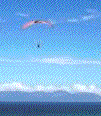
Paragliding |
A good para-glider will always look forward to a thermal around which he will be encircling and gaining height to the cloud base. The flight time can be anything from 5-10 minutes to 2-3 hours.
You should also be familiarized with some of the technical words attached with para-gliding like risers, leading edge, trailing edge, cells, cross pores, thermals, etc. These words may look quite alien in the beginning, but later on you will understand their meanings.
Hang-gliding
Hang-gliding is much like the flight of a bird. You are attached to a kite-like object (though much bigger and heavier in size and weight), negotiate the height, wind, and weather, and fly down the slope. The most important parts in this process are the taking off and landing. The process involves gradual gain or loss of altitude after the pilot takes off with his wings from a hilltop or any other place with a good altitude. The pilot can extend his flight by ridge soaring, thermal soaring or sea frontals. With the coming of new techniques like aero-towing and flatland landing, gliding from the places with low altitudes are also possible.
What do you require to be a hang-glider? Not much if you have love for your life and the determination to save yourself. To be a perfect glider, you need to have a learned skill of gliding, i.e., how to launch yourself, how to move yourself with the glider in the air, a good condition that can make your flight successful (the ability to recognize one will come with time and experience), and the art of landing safely.
Parasailing
In parasailing, you are attached to an instrument called parasail, which in turn would be attached to a jeep or motorboat. Your glide begins when the transport medium with which you are attached starts moving and your glide ends when the transport medium stops. Parasailing in a way is a joyride and not a sport as not much training is required for this.
Before you start sailing, the first step that you will take is to inspect all the gears that are required and ensure that they are ready to flight. In the beginning, take the practice flights with dummy weights; completing which you can start your real fun. Remember that your entire take-offs is into the wind, speed of which must not exceed 15 mph. After several successful practice flights with a dummy weight, it's time to start having real fun. Wear all your safety gears like the helmet, life vest, and foot protection. Now, you are ready for the flight. Step into the harness and hook on the parasail. The boat will idle out into the wind with the help of the launch crew until the towline is taut and extended completely. The sail will be spread up and held by the flight crew from the both side and the signal will be given to power up. Now it is your responsibility that you are not running towards the motorboat but resist the pull, keep the line tight and maintain the balance. The sail is spread and held up on both sides by the flight crew. When all is ready, the signal is given to power up. After four or five steps, you can see yourself flying up in the sky and the joyride will began.
Do not hang from the harness but sit comfortably inside it when flying. You can expect to gain a height of around 200 feet with a 300-feet rope. Steering left or right can be achieved by pulling on the left or right rear risers, located within easy reach. Speed maintenance is the responsibility of the motorboat pilot. Initially, the boat travels into the wind; the boat speed must be adjusted to maintain the desired height. When turning to cross wind or down wind, speed is increased to maintain the relative air speed and desired flying height. The average boat speed will range from 15-30 mph (more during turns).
The flight landing is done with the driver reducing the throttle and the flyer gently drifting downward. The boat must stop before the flyer gets down to avoid dragging him. Hook off the sail when you have landed and wait to be picked up if you are in the water.
IMPORTANT EVENTS
Billing in Kangra Valley of Himachal Pradesh is the most favorite place to organize any hang-gliding event in India. The place also has the distinction of organizing first every paragliding competition according to the rules of Federation Aeronautique International, which makes this venue eligible for future world paragliding championships.
PERMITS AND GOVERNMENT AGENCIES
Except for the places in restricted areas, no government permit is required. For restricted area permits, you can contact the embassy/counsel/high commission of India in your respective country. You can also contact the Ministry of Home Affairs, foreigners' regional registration offices, and the state government officials of the specific states and union territories for these permits.
PRECAUTIONS
Before taking up any of the above-mentioned games, you should check with your medical consultant that you are physically fit to participate.
When into the sports, follow the advice of your instructor religiously. Do not jump ahead of the schedule. It is not possible to touch the cloud base in the first day of training: possibility is that in trying to touch cloud base you would be touching the land base forever. Remember, life is precious.
Follow all the safety measures and wear all the instruments as prescribed.
If you are participating in parasailing in an open area, ensure that any obstructing element is not in your path.
Responsible tourism is the current buzzword today the world over. Protect your environment at all cost; don't destroy it.




