









Chichen Itza
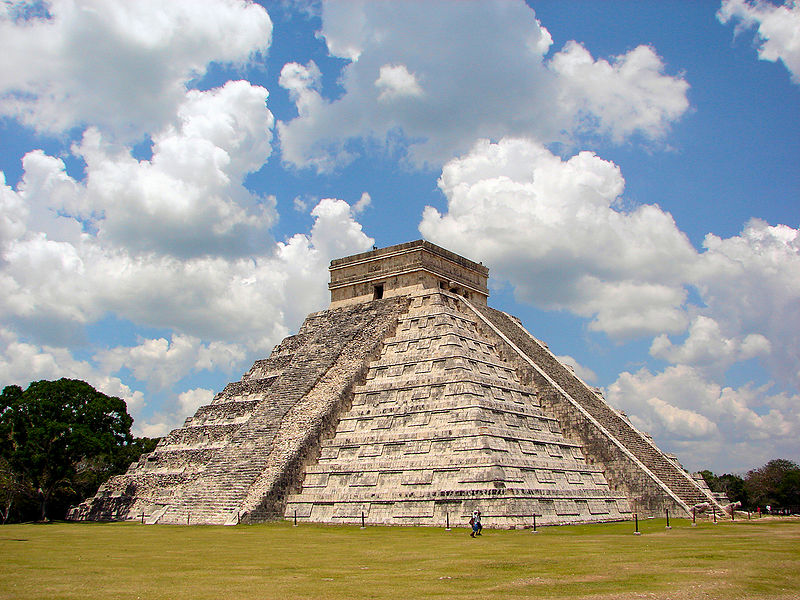
Chichen Itza is a large pre-Columbian archaeological site built by the Maya civilization located in the northern center of the Yucatán Peninsula, in the Yucatán state, present-day Mexico.
Chichen Itza was a major regional focal point in the northern Maya lowlands from the Late Classic through the Terminal Classic and into the early portion of the Early Postclassic period. The site exhibits a multitude of architectural styles, from what is called “Mexicanized” and reminiscent of styles seen in central Mexico to the Puuc style found among the Puuc Maya of the northern lowlands. The presence of central Mexican styles was once thought to have been representative of direct migration or even conquest from central Mexico, but most contemporary interpretations view the presence of these non-Maya styles more as the result of cultural diffusion.
The ruins of Chichen Itza are federal property, and the site’s stewardship is maintained by Mexico’s Instituto Nacional de Antropología e Historia . The land under the monuments, however, is privately-owned by the Barbachano family.
Name and orthography
The Maya name "Chich'en Itza" means "At the mouth of the well of the Itza." This derives from chi', meaning "mouth" or "edge", and ch'e'en, meaning "well." Itzá is the name of an ethnic-lineage group that gained political and economic dominance of the northern peninsula. The name is believed to derive from the Maya itz, meaning "magic," and (h)á, meaning "water." Itzá in Spanish is often translated as "Brujas del Agua (Witches of Water)" but a more precise translation would be Magicians of Water.
The name is often represented as Chichén Itzá in Spanish and when translated into other languages from Spanish to show that both parts of the name are stressed on their final syllables. Other references prefer to employ a more rigorous orthography in which the word is written according to Maya language, using Chich'en Itzá . This form preserves the phonemic distinction between ch' and ch, since the base word ch'e'en begins with a glottalized affricate. The word "Itzá'" has a high rise final "a" that is followed by a glottal stop
There is evidence in the Chilam Balam books that there was another, earlier name for this city prior to the arrival of the Itza hegemony in northern Yucatán. This name is difficult to define because of the absence of a single standard of orthography, but it is represented variously as Uuc Yabnal, Uuc Hab Nal, or Uc Abnal. While most sources agree the first word means seven, there is considerable debate as to the correct translation of the rest. Among the translations suggested are “Seven Bushes,” “Seven Great Houses,” or “Seven Lines of Abnal.”
History
Northern Yucatán is arid, and the interior has no above-ground rivers. There are two large, natural sink holes, called cenotes, that could have provided plentiful water year round at Chichen, making it attractive for settlement. Of the two cenotes, the "Cenote Sagrado" or Sacred Cenote, is the more famous. According to post-Conquest sources, pre-Columbian Maya sacrificed objects and human beings into the cenote as a form of worship to the Maya rain god Chaac. Edward Herbert Thompson dredged the Cenote Sagrado from 1904 to 1910, and recovered artifacts of gold, jade, pottery, and incense, as well as human remains. A recent study of human remains taken from the Cenote Sagrado found that they had wounds consistent with human sacrifice.
Chichen Itza rose to regional prominence towards the end of the Early Classic period. It was, however, towards the end of the Late Classic and into the early part of the Terminal Classic that the site became a major regional capital, centralizing and dominating political, sociocultural, economic, and ideological life in the northern Maya lowlands. The ascension of Chichen Itza roughly correlates with the decline and fragmentation of the major centers of the southern Maya lowlands, such as Tikal.
Some ethnohistoric sources claim that in about 987 a Toltec king named Topiltzin Ce Acatl Quetzalcoatl arrived here with an army from central Mexico, and made Chichen Itza his capital, and a second Tula. The art and architecture from this period shows an interesting mix of Maya and Toltec styles. However, the recent re-dating of Chichen Itza's decline indicates that Chichen Itza is largely a Late/Terminal Classic site, while Tula remains an Early Postclassic site.
Several archaeologists in late 1980s suggested that unlike previous Maya polities of the Early Classic, Chichen Itza may not have been governed by an individual ruler or a single dynastic lineage. Instead, the city’s political organization could have been structured by a "multepal" system, which is characterized as rulership through council composed of members of elite ruling lineages. This theory was popular in the 1990s, but in recent years, the research that supported the concept of the "multepal" system has been called into question, if not discredited. The current belief trend in Maya scholarship is toward the more traditional model of the Maya kingdoms of the Classic southern lowlands.
Chichen Itza was a major economic power in the northern Maya lowlands during its apogee. Participating in the water-borne circum-peninsular trade route through its port site of Isla Cerritos, Chichen Itza was able to obtain locally unavailable resources from distant areas such as central Mexico and southern Central America
According to Maya chronicles, Hunac Ceel, ruler of Mayapan, conquered Chichen Itza in the 13th century. Hunac Ceel supposedly prophecized his own rise to power. According to custom at the time, individuals thrown into the Cenote Sagrado were believed to have the power of prophecy if they survived. During one such ceremony, the chronicles state, there were no survivors, so Hunac Ceel leaped into the Cenote Sagrado, and when removed, prophecized his own ascension.
While there is some archaeological evidence that indicates Chichén Itzá was at one time looted and sacked, there appears to be greater evidence that it could not have been by Mayapan, at least not when Chichén Itzá was an active urban center. Archaeological data now indicates that Chichen Itza fell by around AD 1000, some two centuries before the rise of Mayapan. Ongoing research at the site of Mayapan may help resolve this chronological conundrum.
While Chichén Itzá “collapsed” it does not appear to have been completely abandoned. According to post-Conquest sources, both Spanish and Maya, the Cenote Sagrado remained a place of pilgrimage.
In 1526 Spanish Conquistador Francisco de Montejo successfully petitioned the King of Spain for a charter to conquer Yucatán. His first campaign in 1527, which covered much of the Yucatán peninsula, decimated his forces but ended with the establishment of a small fort at Xaman Ha', south of what is today Cancún. Montejo returned to Yucatán in 1531 with reinforcements and took Campeche on the west coast. He sent his son, Francisco Montejo The Younger, in late 1532 to conquer the interior of the Yucatán Peninsula from the north. The objective from the beginning was to go to Chichén Itzá and establish a capital.
Montejo the Younger eventually arrived at Chichen Itza, which he renamed Ciudad Real. At first he encountered no resistance, and set about dividing the lands around the city and awarding them to his soldiers. Over time, the Maya became more hostile until they eventually laid siege to the Spanish, cutting off their supply line to the coast, and forcing them to barricade themselves among the ruins of ancient city. After the course of several months, with no reinforcements forthcoming, Montejo the Younger attempted an all out assault against the Maya, and lost 150 of his remaining forces. He was forced to abandon Chichén Itzá in 1534 under cover of darkness. By 1535, all Spanish had been driven from the Yucatán Peninsula.
Montejo eventually returned to Yucatán and conquered the peninsula. The Spanish crown later issued a land grant that included Chichen Itza and by 1588 it was a working cattle ranch.
Archaeological research
Chichen Itza entered the popular imagination in 1843 with the book Incidents of Travel in Yucatan by John Lloyd Stephens . The book recounted Stephens’ visit to Yucatán and his tour of Maya cities, including Chichén Itzá. The book prompted other explorations of the city. In 1860, Desire Charnay surveyed Chichén Itzá and took numerous photographs that he published in Cités et ruines américaines.
In 1875, Augustus Le Plongeon and his wife Alice Dixon Le Plongeon visited Chichén, and excavated a statue of a figure on its back, knees drawn up, upper torso raised on its elbows with a plate on its stomach. Augustus Le Plongeon called it “Chaacmol” . Teobert Maler and Alfred Maudslay explored Chichén in the 1880s and both spent several weeks at the site and took extensive photographs. Maudslay published the first long-form description of Chichen Itza in his book, Biologia Centrali-Americana.
In 1894 the United States Consul to Yucatán, Edward H. Thompson purchased the Hacienda Chichén, which included the ruins of Chichen Itza. For 30 years, Thompson explored the ancient city. His discoveries included the earliest dated carving upon a lintel in the Temple of the Initial Series and the excavation of several graves in the Ossario (High Priest’s Temple). Thompson is most famous for dredging the Cenote Sagrado (Sacred Cenote) from 1904 to 1910, where he recovered artifacts of gold, copper and carved jade, as well as the first-ever examples of what were believed to be pre-Columbian Maya cloth and wooden weapons. Thompson shipped the bulk of the artifacts to the Peabody Museum at Harvard University.
In 1913, archaeologist Sylvanus G. Morley persuaded the Carnegie Institution to fund an extensive archaeological project at Chichen Itza, which included mapping the ruins and restoring several of the monuments. The Mexican Revolution and the following government instability prevented the Carnegie from beginning work until 1924. Over the course of 10 years, the Carnegie researchers excavated and restored the Temple of Warriors and the Caracol. At the same time, the Mexican government excavated and restored El Castillo and the Great Ball Court.
In 1926, the Mexican government charged Edward Thompson with theft, claiming he stole the artifacts from the Cenote Sagrado and smuggled them out of the country. The government seized the Hacienda Chichén. Thompson, who was in the United States at the time, never returned to Yucatán. He wrote about his research and investigations of the Maya culture in a book People of the Serpent published in 1932. He died in New Jersey in 1935. In 1944 the Mexican Supreme Court ruled that Thompson had broken no laws and returned Chichen Itza to his heirs. The Thompsons sold the hacienda to tourism pioneer Fernando Barbachano Peon, and his heirs own the property today.
There have been two later expeditions to recover artifacts from the Cenote Sagrado, in 1961 and 1967. The first was sponsored by the National Geographic, and the second by private interests. Both projects were supervised by Mexico's National Institute of Anthropology and History (INAH). INAH has conducted an ongoing effort to excavate and restore other monuments in the archaeological zone, including the Ossario, Akab D’zib, and several buildings in Chichén Viejo
Tourism
Tourism has been a factor at Chichen Itza for more than a century. John Lloyd Stephens, who popularized the Maya Yucatán in the public’s imagination with his book Incidents of Travel in Yucatan, inspired many to make a pilgrimage to Chichén Itzá. Even before the book was published, Benjamin Norman and Baron Emanuel von Friedrichsthal traveled to Chichen after meeting Stephens, and both published the results of what they found. Friedrichsthal was the first to photograph Chichen Itza, using the recently invented daguerreotype.
After Edward Thompson in 1894 purchased the Hacienda Chichén, which included Chichen Itza, he received a constant stream of visitors. In 1910 he announced his intention to construct a hotel on his property, but abandoned those plans, probably because of the Mexican Revolution.
In the early 1920s, a group of Yucatecans, led by writer/photographer Francisco Gomez Rul, began working toward expanding tourism to Yucatán. They urged Governor Felipe Carrillo Puerto to build roads to the more famous monuments, including Chichen Itza. In 1923, Governor Carrillo Puerto officially opened the highway to Chichen Itza. Gomez Rul published one of the first guidebooks to Yucatán and the ruins.
Gomez Rul's son-in-law, Fernando Barbachano Peon, started Yucatán’s first official tourism business in the early 1920s. He began by meeting passengers that arrived by steamship to Progreso, the port north of Merida, and persuading them to spend a week in Yucatán, after which they would catch the next steamship to their next destination. In his first year Barbachano Peon reportedly was only able to convince seven passengers to leave the ship and join him on a tour. In the mid-1920s Barbachano Peon persuaded Edward Thompson to sell 5 acres (20,000 m2) of property next to Chichen for a hotel. In 1927, the Mayaland Hotel opened, just north of the Hacienda Chichén, which had been taken over by the Carnegie Institution.
In 1944, Barbachano Peon purchased all of the Hacienda Chichén, including Chichen Itza, from the heirs of Edward Thompson. Around that same time the Carnegie Institution completed its work at Chichen Itza and abandoned the Hacienda Chichén, which Barbachano turned into another seasonal hotel.
In 1972, Mexico enacted the Ley Federal Sobre Monumentos y Zonas Arqueológicas, Artísticas e Históricas that put all the nation's pre-Columbian monuments, including those at Chichen Itza, under federal ownership. There were now hundreds, if not thousands, of visitors every year to Chichen Itza, and more were expected with the development of the Cancún resort area to the east.
In the 1980s, Chichen Itza began to receive an influx of visitors on the day of the spring equinox. Today several thousand show up to see the light-and-shadow effect on the Temple of Kukulcan in which the feathered serpent god supposedly can be seen to crawl down the side of the pyramid.
Chichen Itza, a UNESCO World Heritage Site, is the second-most visited of Mexico's archaeological sites.The archaeological site draws many visitors from the popular tourist resort of Cancún, who make a day trip on tour buses. In 2007, Chichen Itza's El Castillo was named one of the New Seven Wonders of the World after a worldwide vote. Despite the fact that the vote was sponsored by a commercial enterprise, and that its methodology was criticized, the vote was embraced by government and tourism officials in Mexico who project that as a result of the publicity the number of tourists expected to visit Chichen will double by 2012. The ensuing publicity re-ignited debate in Mexico over the ownership of the site, with some representatives of the government such as the secretary of the parliamentary culture committee, Jose Alfonso Suarez del Real, calling for the land to be put in public ownership, by expropriation if necessary.
Over the past several years, INAH, which manages the site, has been closing monuments to public access. While visitors can walk around them, they can no longer climb them or go inside their chambers. The most recent was El Castillo, which was closed after a San Diego, Calif., woman fell to her death in 2006.




